In short
AI tools recommend businesses they can find, read and trust. ChatGPT search uses OpenAI’s own crawler and web search results, including Bing’s, so being indexed in Bing matters. Google’s AI Overviews draw on Google’s normal search index. The things that help are much the same as good SEO: let AI crawlers in, have a clear page for each service and area, answer questions plainly, keep your business details consistent, and earn reviews and mentions on other trusted sites.
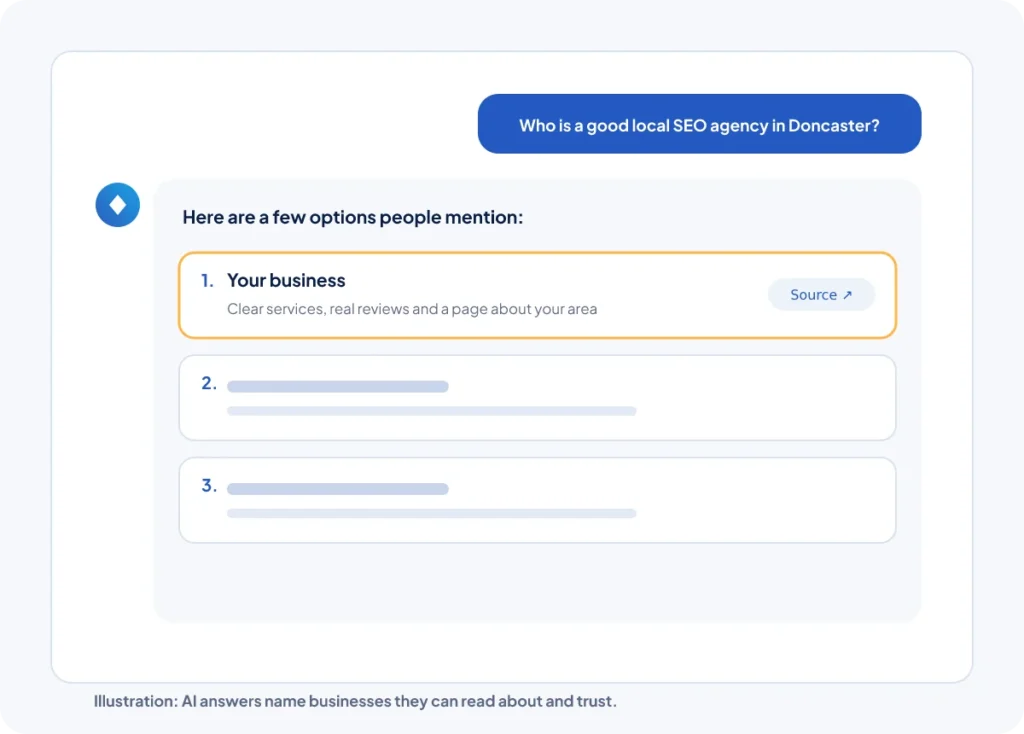
“Who is a good electrician near me?” Customers no longer only type that into Google. Many now ask ChatGPT, Perplexity, Microsoft Copilot or read Google’s AI Overview at the top of the results. These tools often name a few businesses, and the people asking tend to trust those names.
So how do you become one of the businesses they mention? Nobody can promise it, but there are clear steps that make it much more likely.
How AI tools find businesses
AI assistants do not “know” every business. When someone asks for a recommendation, most of them search the web, read a few pages and then write an answer. That means they rely on:
- Search indexes. ChatGPT search uses OpenAI’s own crawler, called OAI-SearchBot, alongside web search results, including Bing’s. Copilot is built on Bing. Google’s AI Overviews come from Google’s own index.
- Your website. If the AI can reach and read your pages, it can understand what you do and where.
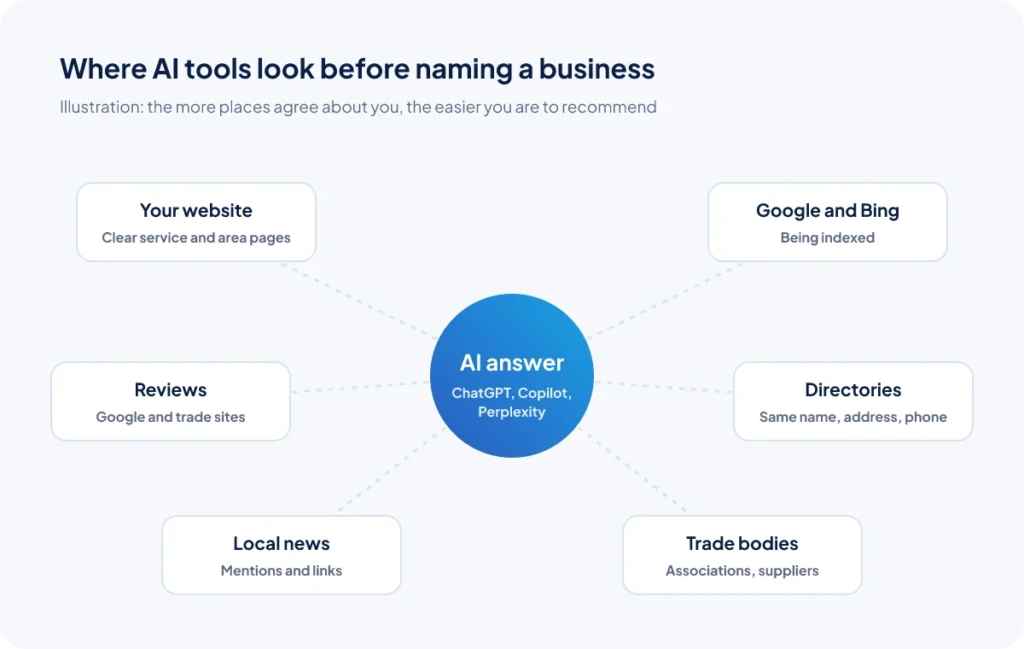
- Other websites about you. Reviews, directories, local news and industry sites help the AI decide whether you are a sensible recommendation.
The upshot: if search engines cannot find you, AI tools usually cannot either.
9 steps to help AI tools recommend your business
1. Let AI crawlers read your website
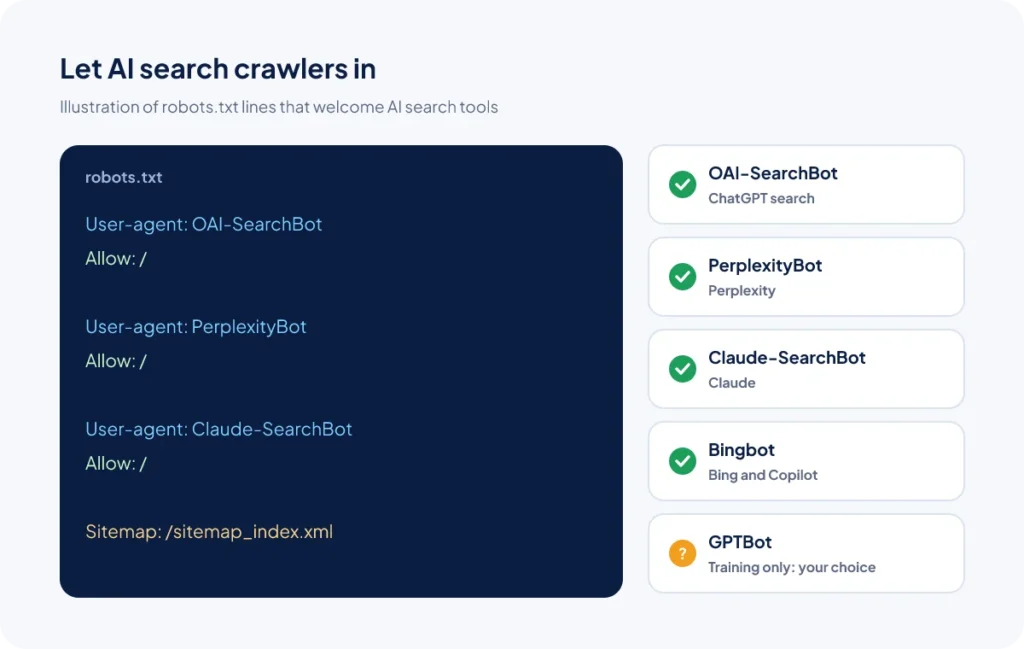
Your robots.txt file tells crawlers what they can visit. Make sure it does not block the search crawlers used by AI tools, such as OAI-SearchBot (ChatGPT search), PerplexityBot (Perplexity) and Claude-SearchBot (Claude), as well as Googlebot and Bingbot. OpenAI also runs GPTBot, which collects data for training; blocking that one does not stop you appearing in ChatGPT search.
2. Get indexed in Bing, not just Google
Many businesses only ever set up Google Search Console. Add your site to Bing Webmaster Tools as well and submit your sitemap. You can import your site straight from Google Search Console in a few clicks.
3. Make one clear page for each service and each area
AI tools match questions to pages. A page called “Emergency Electrician in Bradford” that explains exactly what you do, where and how to contact you is easy to match. A single page listing twenty services is not.
4. Answer questions in plain English
Write the way people ask. Start sections with a short, direct answer, then add the detail. Add a frequently asked questions section to important pages. AI tools often pull out these short, clear answers.
5. Keep your business details the same everywhere
Your business name, address, phone number, hours and services should match on your website, Google Business Profile, Bing Places, Apple Maps, Facebook and directories. Conflicting details make you look less reliable to both search engines and AI.
6. Earn genuine reviews on several platforms
When people ask AI for “the best” business, reviews are a strong signal. Ask happy customers to review you on Google, and on the platforms that matter in your trade. Reply to them. Never buy or fake reviews.
7. Get mentioned on other trusted websites
AI tools pay attention to what other sites say about you: local news, trade associations, suppliers, community groups, “best of” lists and industry directories. Being mentioned in the right places builds the trust that leads to recommendations. This is the modern version of good link building.
8. Add structured data (schema)
Schema is code that labels your information clearly: business type, address, opening hours, services, reviews and FAQs. It helps machines read your pages correctly.
9. Consider an llms.txt file
llms.txt is a newer, proposed standard: a simple file that lists your key pages with a short summary for AI tools. It is not yet clear how much the big AI tools use it, but it is quick to add and does no harm. Our own site has one.
Check how AI sees you now. Ask ChatGPT, Perplexity and Copilot: “Who are the best [your service] in [your town]?” and “What does [your business name] do?”. Note which businesses they mention and which sources they link to. Those sources show you where you need to appear.
What does not work
- Stuffing pages with keywords. AI tools are good at reading meaning. Clear, helpful writing works better.
- Fake reviews and made-up “best of” lists. They break platform rules and can damage trust in your business.
- Blocking all bots to “protect” your content. If AI search tools cannot read your site, they are much less likely to recommend you.
- Hidden text written only for AI. Write for people. That is what AI tools are trying to understand.
Good SEO is the foundation
Almost everything that helps AI recommend you also helps you rank on Google: fast, clear pages, consistent details, reviews and genuine mentions. If you are working through our local SEO checklist, you are already doing most of it. And if your pages get seen but not clicked, read why you get impressions but no clicks.
Our SEO services now cover AI search as standard: crawler access, Bing indexing, schema, clear service and location pages, and building the mentions that earn recommendations. Our content writing is done in the plain, answer-first style that both people and AI tools prefer.
Is your business visible to AI search?
We will check how Google, Bing and AI tools see your business and send you a free proposal to improve it.
Frequently asked questions
How does ChatGPT decide which businesses to recommend?
When ChatGPT searches the web, it reads pages found by OpenAI’s crawler and web search results, then writes an answer based on what it finds. Businesses with clear websites, consistent details, good reviews and mentions on other trusted sites are easier for it to find and recommend.
Can I pay to be recommended by ChatGPT?
You cannot pay to change what ChatGPT recommends in its normal answers. The way to improve your chances is to make your business easy to find, understand and trust online.
Should I block GPTBot in robots.txt?
That is your choice. GPTBot collects data for training OpenAI’s models. Blocking it does not stop you appearing in ChatGPT search, which uses OAI-SearchBot. Do not block OAI-SearchBot if you want to show up in ChatGPT search.
Does Bing really matter for AI search?
Yes. Microsoft Copilot is built on Bing, and ChatGPT search uses web search results, including Bing’s. Adding your site to Bing Webmaster Tools and submitting your sitemap is quick and worth doing.
Is SEO still worth it if people use AI instead of Google?
Yes. AI tools rely on search indexes and on the same signals SEO builds: clear pages, consistent business details, reviews and links. Google is also still where most people search for local services.