Hourly Rate Calculator UK
Use this free hourly rate calculator to turn a UK salary into an hourly, daily, weekly and monthly rate, or turn an hourly rate back into a salary. Self-employed? Switch to the second tab to work out what you should charge per hour once holidays, costs and unpaid admin time are taken into account.
- Free, no sign-up
- Works on your phone
- Nothing you type is stored
- Last checked 27 November 2026
Your gross pay (before tax). Choose per hour to turn an hourly rate into a salary.
Your hourly rate
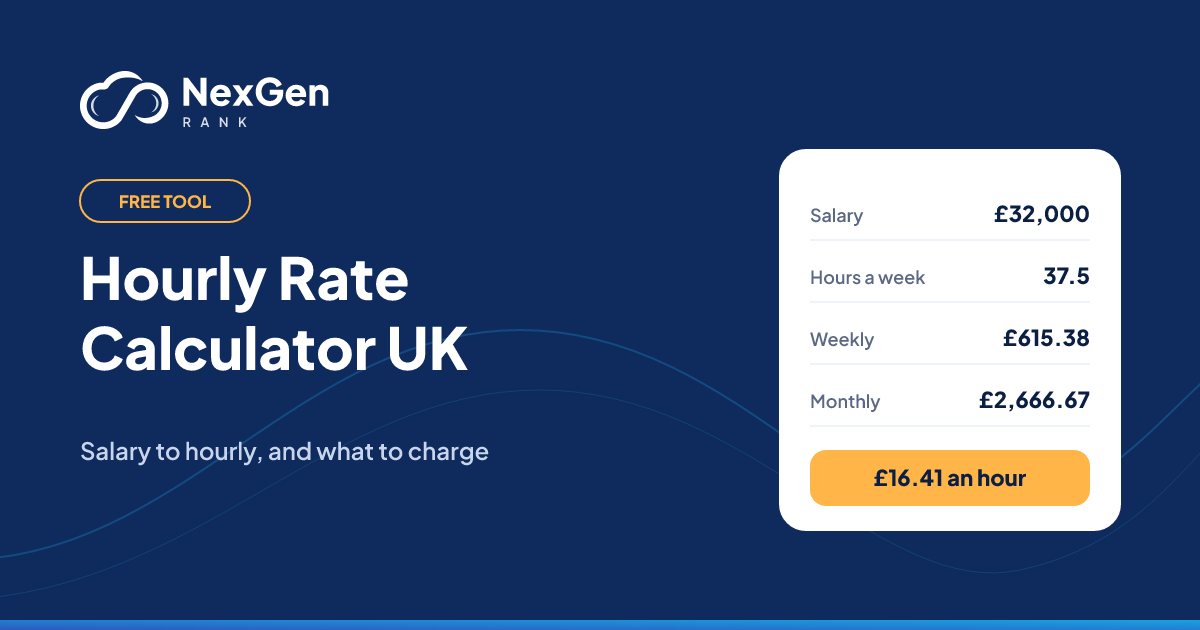
£16.41
| Per hour | £16.41 |
|---|---|
| Per day | £123.08 |
| Per week | £615.38 |
| Per month | £2,666.67 |
| Per year | £32,000.00 |
Figures are before Income Tax, National Insurance and pension contributions.
Van, fuel, insurance, tools, phone, software, accountant, marketing.
The share of your working hours you can charge for, after travel, quoting and admin.
Extra on top for quiet weeks, late payers and growth.
Suggested hourly rate
£35.79
| Minimum hourly rate (break-even) | £32.54 |
|---|---|
| Suggested day rate | £286.35 |
| Hourly rate with VAT (if VAT-registered, 20%) | £42.95 |
| Working days a year | 225 |
| Billable hours a year | 1,260 |
Your income figure is before Income Tax and National Insurance, so set money aside for your tax bill.
Free to use. Everything is worked out in your browser: nothing you type is stored or sent anywhere.
In short
For employees, your hourly rate is your yearly pay divided by the hours you are paid for in a year: £32,000 at 37.5 hours a week is £16.41 an hour. If you work for yourself, do not just divide a salary by 1,950 hours. Add your business costs, then divide by the hours you can actually bill, which is far fewer once holidays, sick days, quoting and admin come out.
How to use the hourly rate calculator
- 1
Step 1
Pick a tab
Salary to hourly for a job, or "What should I charge?" if you are self-employed.
- 2
Step 2
Enter your pay
Type an amount and choose per year, month, week, day or hour.
- 3
Step 3
Check your hours
Set hours a week, days a week and paid weeks. 37.5 hours and 52 weeks are the UK norm.
- 4
Step 4
Read the results
Every rate updates as you type. Change any number to compare options.
How the hourly rate calculator works
For a salaried job the sum is simple. UK salaries are paid across all 52 weeks of the year, including your paid holiday, so the calculator divides your yearly pay by the hours you are paid for:
Hourly rate = yearly pay ÷ (hours a week × paid weeks a year)
Worked example: a salary of £32,000 for a 37.5-hour week. That is 37.5 × 52 = 1,950 paid hours a year, and £32,000 ÷ 1,950 = £16.41 an hour. The same salary is £2,666.67 a month (÷ 12), £615.38 a week (÷ 52) and £123.08 a day (÷ 260 working days).
It works the other way too. Choose “per hour” and enter £15: the calculator multiplies by 1,950 hours and shows £29,250 a year. All figures are before tax, National Insurance and pension contributions, which is how salaries are normally quoted in the UK.
Salary to hourly rate: quick UK table
Here are common UK salaries converted with the hourly rate calculator, for a full-time 37.5-hour week over 52 weeks (1,950 hours) and 5 days a week (260 days). If you work 40 hours a week, divide by 2,080 hours instead; for 35 hours, divide by 1,820.
| Salary a year | A month | A week | A day | An hour |
|---|---|---|---|---|
| £20,000 | £1,666.67 | £384.62 | £76.92 | £10.26 |
| £25,000 | £2,083.33 | £480.77 | £96.15 | £12.82 |
| £30,000 | £2,500.00 | £576.92 | £115.38 | £15.38 |
| £35,000 | £2,916.67 | £673.08 | £134.62 | £17.95 |
| £40,000 | £3,333.33 | £769.23 | £153.85 | £20.51 |
| £45,000 | £3,750.00 | £865.38 | £173.08 | £23.08 |
| £50,000 | £4,166.67 | £961.54 | £192.31 | £25.64 |
| £60,000 | £5,000.00 | £1,153.85 | £230.77 | £30.77 |
Part-time? Enter your actual weekly hours. A pro-rata salary of £15,000 for 20 hours a week is £15,000 ÷ (20 × 52) = £14.42 an hour.
What should I charge per hour if I am self-employed?
This is where most people under-charge. An employee is paid for 1,950 hours a year whether or not they are busy. When you work for yourself, nobody pays you for holidays, bank holidays, sick days, travelling, quoting, chasing invoices or doing your accounts. You also pay your own costs: tools, van, insurance, phone, software, accountant and advertising.
So the “What should I charge?” tab works out your rate from the hours you can really bill:
- Working days = (52 weeks − weeks off) × days a week − sick days.
- Billable hours = working days × hours a day × the share of time that is paid work.
- Hourly rate = (the income you want + business costs) ÷ billable hours.
- Then add a small buffer for quiet spells and late payers.
Worked example: you want £35,000 a year before tax, with £6,000 of business costs. You take 6 weeks off (holidays and bank holidays), allow 5 sick days, and work 8-hour days, 5 days a week. That is (52 − 6) × 5 − 5 = 225 working days. If 70% of your time is paid work, you can bill 225 × 8 × 0.7 = 1,260 hours. (£35,000 + £6,000) ÷ 1,260 = £32.54 an hour, or £35.79 an hour with a 10% buffer. That is a day rate of £286.35.
Compare that with the “salary” answer of £35,000 ÷ 1,950 = £17.95 an hour. Charging £17.95 would leave you thousands of pounds short. That gap is why the self-employed tab exists.
UK rules that affect your hourly rate
National Living Wage. If you employ staff, their pay must work out at or above the legal minimum for every hour worked. The calculator warns you if an hourly rate falls below the National Living Wage. The rates set by the government are:
| Age group | From 1 April 2026 | From 1 April 2027 |
|---|---|---|
| 21 and over (National Living Wage) | £12.71 | £13.21 |
| 18 to 20 | £10.85 | £11.27 |
| 16 to 17 | £8.00 | £8.31 |
| Apprentices | £8.00 | £8.31 |
At £12.71, a full-time 37.5-hour week works out at £24,784.50 a year. From April 2027, at £13.21, it is £25,759.50. Always check the latest figures on GOV.UK.
Holiday. Most workers are entitled to 5.6 weeks of paid holiday a year, which is 28 days for someone working 5 days a week (bank holidays can be counted in this). Because holiday is paid, dividing a salary by 52 weeks gives the right hourly figure for employees. If you are self-employed, those 5.6 weeks are unpaid, which is why you enter them as weeks off.
VAT. If your taxable turnover goes over £90,000 in any 12 months, you must register for VAT and add 20% to most prices. The self-employed tab shows your rate with VAT added, so you can quote either way.
Tips to get your hourly rate right
- Quote by the job, not the hour, where you can. Customers compare prices for the result, and you keep the reward when you work quickly. Our markup calculator has a job price tab for trades.
- Set a minimum charge or call-out fee, so short jobs still cover your travel and time.
- Track your hours for a month, including quoting and admin. Most people find their billable share is lower than they thought.
- Review your rate every April, when costs, wages and the National Living Wage go up.
- Raise prices with notice. Tell regular customers a month ahead; most will stay if your service is good.
- Win better-paid work. Being easy to find on Google for the jobs you want means you can choose the work, not just take any job at any price.
Hourly rate calculator: common questions
How do I calculate my hourly rate from my salary?
Divide your yearly salary by the hours you are paid for in a year. For a 37.5-hour week that is 37.5 × 52 = 1,950 hours, so £30,000 a year is £30,000 ÷ 1,950 = £15.38 an hour. The calculator at the top of this page does it for any hours.
What is £30,000 a year as an hourly rate?
At 37.5 hours a week it is £15.38 an hour. At 40 hours a week it is £14.42 an hour, and at 35 hours it is £16.48. That is £2,500 a month before tax.
How many working hours are there in a year in the UK?
A full-time job of 37.5 hours a week is paid for 1,950 hours a year (37.5 × 52), including paid holiday. At 40 hours a week it is 2,080 hours. Hours actually worked are lower, because about 5.6 weeks are paid holiday.
What is the minimum wage in the UK?
From 1 April 2026 the National Living Wage for workers aged 21 and over is £12.71 an hour. It rises to £13.21 an hour on 1 April 2027. Lower rates apply to 16 to 20 year olds and apprentices. See the table on this page or GOV.UK for all rates.
How much should I charge per hour if I am self-employed?
Add the income you want to your yearly business costs, then divide by the hours you can actually bill, not 1,950. After holidays, sick days, travel and admin, many sole traders bill well under 1,500 hours a year. Use the "What should I charge?" tab to work out your own figure.
Is the hourly rate before or after tax?
Before tax. Salaries in the UK are normally quoted gross, before Income Tax, National Insurance and pension contributions, so the calculator works with gross pay. Your take-home pay will be lower.
Should I include holiday when working out an hourly rate?
For a salaried job, divide by all 52 weeks, because your holiday is paid. If you are self-employed, take your holiday weeks out of your working year, because you are not paid for them, and your rate must cover them.
About this tool
Made by NexGen Rank, a digital marketing agency that helps UK local businesses get found on Google and win more customers. We built it because our clients kept asking for these numbers and links, and the free versions online were full of sign-ups and adverts.
Last checked: 27 November 2026. Minimum wage rates are checked against GOV.UK and the calculator switches to the April 2027 rate on 1 April 2027 by itself.
Sources:
- GOV.UK: National Minimum Wage and National Living Wage rates
- GOV.UK: Minimum wage rates for 2027
- GOV.UK: Holiday entitlement
- GOV.UK: VAT registration thresholds
This hourly rate calculator gives estimates to help you plan. It is not tax, legal or financial advice; speak to an accountant about your own situation. Everything is worked out in your own browser: nothing you type is saved or sent to us.
More free tools for your business
- Markup Calculator UKWork out markup, margin, profit and selling price, with VAT, plus a job price calculator for trades.Use the free tool →
- Free QR Code GeneratorMake QR codes for links, WiFi, WhatsApp, contact cards, email and phone. Free, no sign-up, and they never expire.Use the free tool →
- WiFi QR Code GeneratorMake a QR code guests can scan to join your WiFi, and print a ready-made sign.Use the free tool →
- Google Review Link GeneratorGet your direct Google review link, a QR code and ready-to-send review request messages.Use the free tool →
Helpful guides and services
Add this free tool to your website
Run a trade body, a business club, a council page or a blog for small businesses? You are welcome to put this hourly rate calculator on your site for free. Copy the code and paste it into any page. It stays up to date automatically and loads nothing from any other company.
Want more of the jobs worth charging for? Get a free proposal

In a hurry? Call +92 320 443 0153 or book a free call.