In short
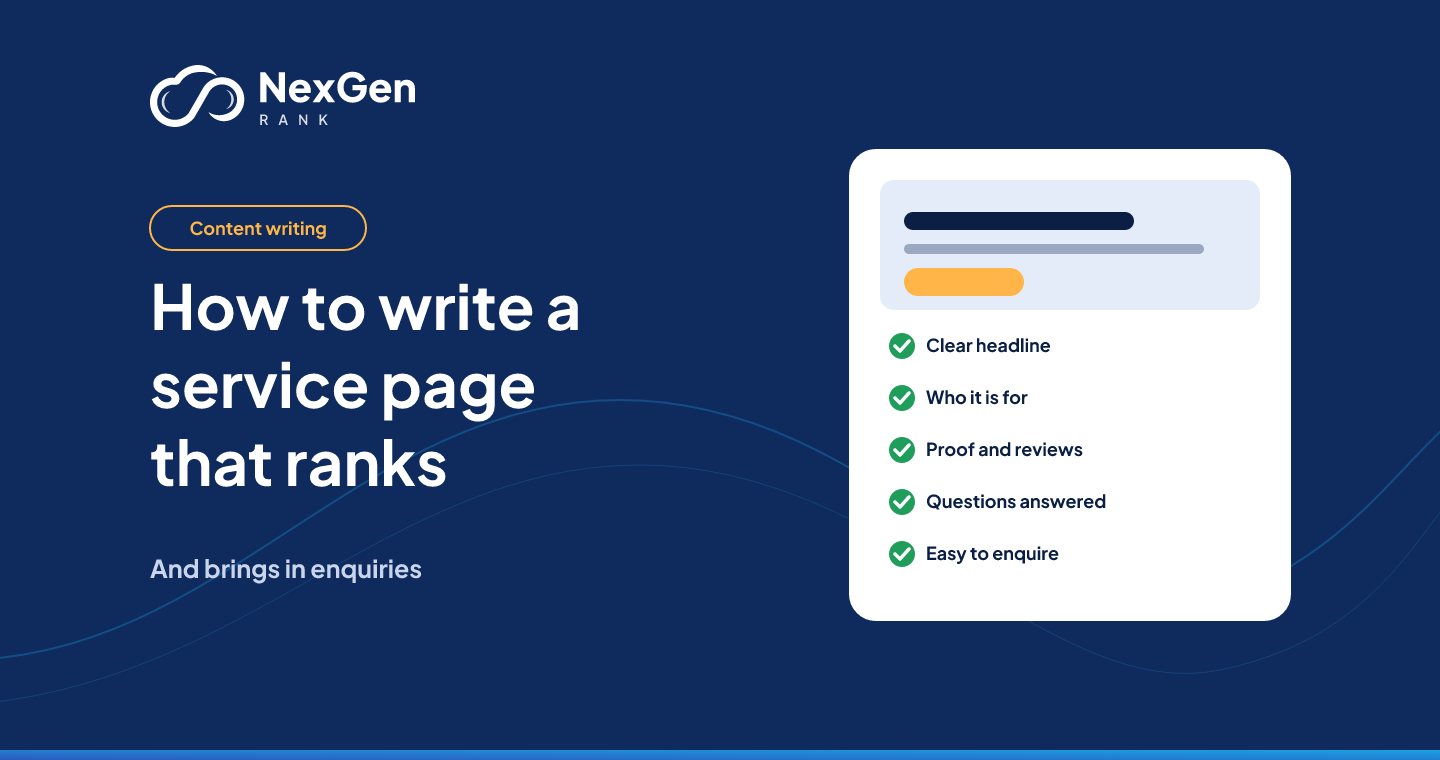
A service page that ranks and converts covers one service, says what it is and where in the title and main heading, answers the customer’s main question near the top, explains what is included and how it works, shows proof (photos, reviews, accreditations), answers common questions, and makes it easy to enquire from every part of the page.
For most local businesses, service pages matter more than any blog post. They are the pages Google shows when someone searches for what you do, and the pages that turn visitors into calls. Yet many are just a few lines of text and a phone number.
Here is how to write a service page that works for both Google and your customers.
Step 1: One page, one service
If you offer boiler repair, boiler installation and bathroom fitting, give each one its own page. A single “Services” page that mentions everything gives Google nothing specific to rank. It also forces visitors to hunt for the part they care about.
Step 2: Know what people search for
Before you write, think about how customers describe the service: “boiler repair”, “boiler not working”, “emergency boiler engineer”. Search them yourself and look at the results, the “People also ask” questions and the searches suggested at the bottom of the page. Use the words your customers use, not industry jargon.
Step 3: Write a title and heading that match the search
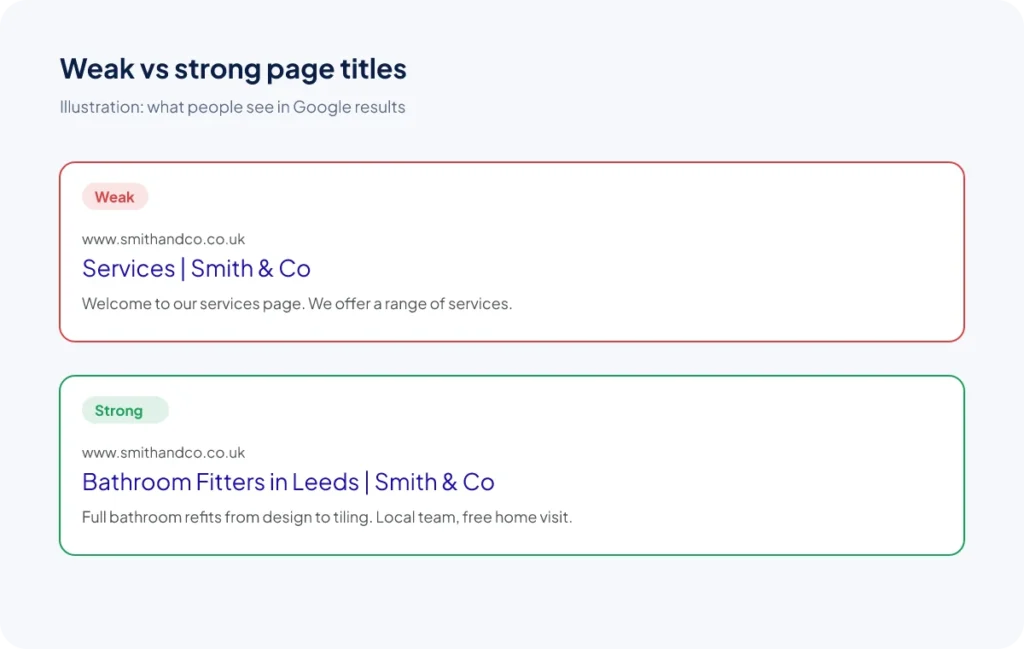
- Page title: service + place + your name, around 60 characters. For example, “Bathroom Fitters in Leeds | Smith & Co”.
- Meta description: what you do, why choose you and what to do next, around 150 characters.
- Main heading (H1): clear and specific, such as “Bathroom fitting in Leeds”.
Step 4: Use a structure that answers questions in order
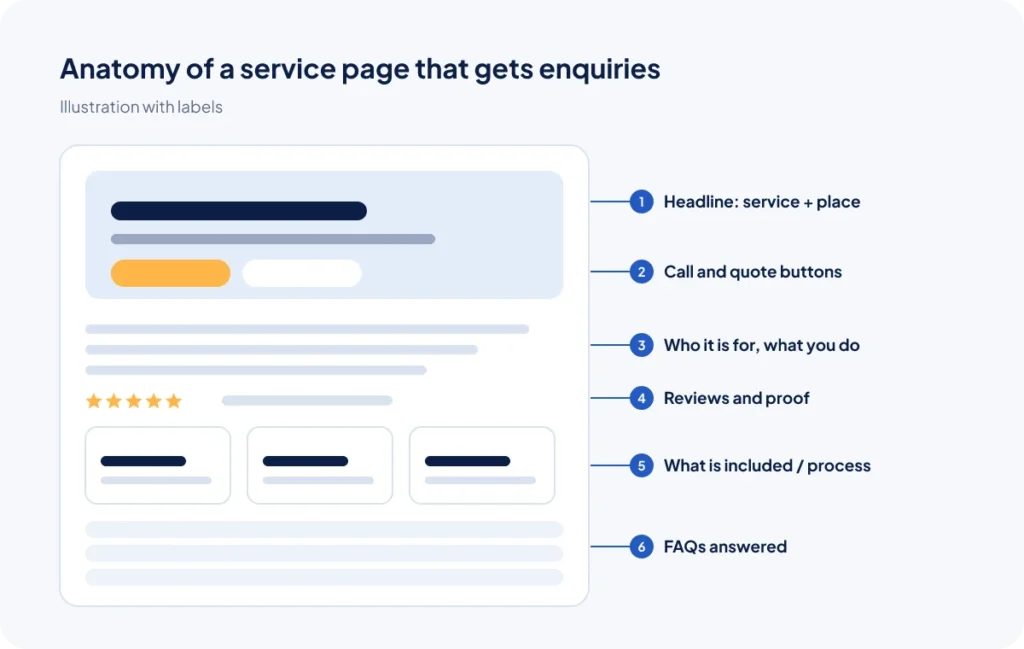
- The opening: one or two sentences saying exactly what you do, where, and for whom. Add a call button and a quote button.
- Who it is for and the problems you solve: describe the situations your customers are in.
- What is included: the steps, materials, timescales and what happens on the day.
- Proof: photos of real jobs, reviews that mention this service, accreditations and guarantees.
- Areas covered: the towns you serve, linking to your location pages.
- Frequently asked questions: the real questions customers ask on the phone.
- A clear next step: a short form and phone number at the end.
Step 5: Write in plain English
- Lead with the answer, then explain.
- Use short paragraphs, headings and bullet lists so people can scan.
- Say “you” and “we”, not “the client” and “the company”.
- Be specific: “most bathrooms take five to eight working days” beats “fast turnaround”.
- Do not stuff keywords. Write naturally; Google understands related words.
Step 6: Link it up
Link to the service page from your menu, home page and related blog posts. Link from the service page to related services and to your area pages. Internal links help Google find and understand your pages, and help visitors move to what they need.
Service page checklist
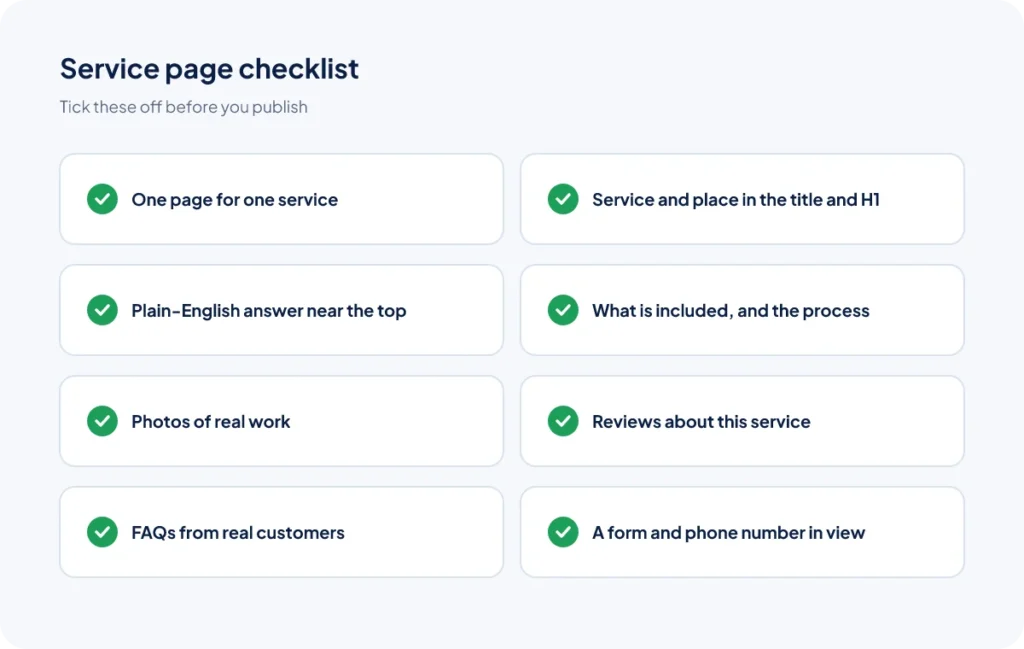
Update, do not abandon. Add new photos, reviews and answers to new questions every few months. A page that grows with real detail tends to do better over time than one written once and forgotten.
If your pages get seen in Google but not clicked, read why you get impressions but no clicks. If your whole site needs a rethink, see 10 signs you need a new website.
Our content writing and on-page SEO services plan, write and improve service pages for local businesses, in your voice, with the proof and structure that bring in enquiries.
Want your service pages reviewed?
We will look at your main service pages and send you a free proposal showing what to rewrite, add and link to rank higher and win more enquiries.
Frequently asked questions
How long should a service page be?
Long enough to fully answer what a customer needs to know before getting in touch. For most local services that means several hundred words or more, with headings, photos, reviews and FAQs, but never padding for the sake of length.
Should every service have its own page?
Yes, for your main services. A separate page for each gives Google something specific to rank for that search and gives customers exactly what they are looking for.
What should a service page title include?
The service, the place and your business name, in around 60 characters. For example: “Emergency Plumber in Doncaster | Your Business”.
Do FAQs on service pages help SEO?
They help customers get answers quickly and give the page useful, specific content. Use real questions customers ask you, and answer them directly.
How often should I update my service pages?
Every few months, add new photos, reviews and answers to new questions, and check timescales, services and areas are still correct.